Showing posts with label history. Show all posts

Dec 18, 2011

Catemaco and the Four Winds

In 1933, the somnolent village of Catemaco first made international headlines.

On the 10th of June 1933, two Spanish airmen set off from Spain for Cuba to fly 40 hours in the first successful  non stop crossing of the central Atlantic in a single engine aircraft.

Early morning on June 20th the plane left Cuba for Mexico City, where 60 000 celebrants eagerly awaited the plane`s arrival.

Curiously, the flight was only planned to Villa Hermosa in the neighboring state of Tabasco, where it never landed. From there, the Four Winds (Cuatro Vientos in Spanish) disappeared into the haze of mystery.

The Mexican Air Force immediately dispatched a squadron of search and rescue planes, one of which later made an emergency landing in nearby San Andrés Tuxtla and provided Los Tuxtlas with the thrill of its first aviation experience.

The flight of the Cuatro Vientos was the equivalent of the Lindbergh experience in the Latin world and received huge press and radio coverage.

After the unsuccessful air search, hampered by bad weather, the then Mexican president,  presuming the crash occurred in Los Tuxtlas, ordered an expeditionary force to begin a ground search. The operations center was to be Catemaco, and the sleepy village became inundated with  reporters and searchers, depleting the shelves of its few grocery stores.

Locals guided the unsuccessful searchers through the surrounding jungles, where two died of snake bites and many more came down with tropical diseases.

The fate of the aircraft and its crew has never been officially explained. The most popular story claims the aviators crashed in the nearby Mazateca region of the Oaxaca mountains and were then killed and buried by natives. In 2008 a Mexican colonel reported it actually crashed in Veracruz mountains north of Los Tuxtlas.
Conspiracy buffs of course believe the Mexican government buried the facts to avoid international embarrassment.


Catemaco had gotten its first taste of flying, and soon an airfield was leveled near the El Cerrito hill which is now the center of the town. Nearby San Andrès actually operated an airfield with scheduled flights to a number of cities. All that ended coincident with an airliner flying into a mountain in the 1950's.

Both airfields have disappeared. A dirt strip outside of San Andrés receives an occasional aircraft and for years now, Los Tuxtlas is humming with political promises of a new airport to be built.


Read about the history of the flight, in Spanish, of course:
http://historiasindelebles.wordpress.com/2011/06/01/chilchotla-esconde-un-secreto-el-final-del-cuatro-vientos/

Oct 27, 2011

Terry's Catemaco

Remember the good ol' days when the hunting was great in Catemaco?
This is a snippet of Terry's Guide to Mexico from 1965. 


That was also the first time I saw Catemaco. For about 15 minutes, on a cold, rain storming day from a one horse gas station, on the way to Quintana Roo.

Sep 28, 2011

Catemaco Olmecs


Politicians of Catemaco pretend that Catemaco was civilized during the Olmec stage of local pre-hispanic history.

There is very little or no proof. Excavations on Isla Agaltepec and recently in Teotepec show only rudimentary occupation before 0 BC.

Nevertheless, politically it now seems to have become imperative to link Catemaco to the Olmec culture.

The first documented presence of settlers in Los Tuxtlas stems from sediment studies of a lake near San Andrés Tuxtla (neighboring municipality) which dated corn pollen about 5000 years ago. 

The next nearby presence dates from 3600 years ago when Olmecs initiated the first major Pre-Columbian civilization in Mexico around San Lorenzo Tenochtitlan southeast of present day Acayucan. The Olmecs progessively abandoned their centers wth the last one, actually in Los Tuxtlas, at Tres Zapotes, west of present Santiago Tuxtla, fading out about 2500 years ago, but continuing in a derivative version possibly until 900 AD
During its heyday, Olmec culture extended throughout central Mexico, extending to the Pacific and central America.

Apart from Tres Zapotes, few other significant archaeological finds of their presence in Los Tuxtlas have been made, including a sculpture workshop and assorted figurines primarily in Hueyapan, a municipality southeast of Catemaco.

The only significant find in Catemaco was documented in 1923, when Franz Blom, one of the earliest explorers of the area saw a small statue of Homshuk, a supposed Olmec deity parked next to a hovel in the city. Supposedly the figurine had been found on Isla Tenaspi, near the so called monkey islands.

The Olmec culture is one of the least understood in Mexico and abounds with speculations. They left no written, decipherable records, and the few that do exist are based on interpretations of  Maya hieroglyphs. Nevertheless, it is said  that they spoke a version of  the Mixe Zoquean language family, primarily based on there still being remnant speakers of that language in the Olmecs' principal known areas generally around the Isthmus of Tehuantepec.

The third largest of this group of speakers are Popolucas, an indigenous tribe still present in the southern Los Tuxtlas, still dominant in Soteapan and well represented in northern Hueyapan, both neighbors of Catemaco.

Now here it becomes interesting. 
The Catemaco/ Los Tuxtlas area became largely depopulated after 200 BC, possibly because of  volcanism. The next substantial civilization were Nahuatl speakers arriving around 400 AD from the Tehotihuacan civilization centered on Mexico City. They erected Matacapan, a complex of perhaps 50,000 or more, northwest of Catemaco. Numerous subsidiary remnants have been found throughout Catemaco and in other nearby municipalities. 

Most of the historical artifacts still in Los Tuxtlas museums or cluttering up sidewalks, stem from that era. By the end of  the Teotihuacan hegemony, the Matacapan Nahuas where then over run by Pipils, a Nahuatl dialect tribe of speakers, possibly from Cholula. By 900 the Pipils were gone, on their way to form minor empires in Central America.

By the time of the Spanish conquest, Los Tuxtlas was principally a Nahuatl speaking territory. a hundred years later, it is estimated that 80% of the natives had died off.


So what happened to the Olmecs and speakers of their language? I have no idea.

Almost all place names in Los Tuxtlas are Nahuatl, with a few of Pipil origins, and a even less with Popoluca roots. Even the Popoluca territory, which within oral history included the eastern part of Laguna Catemaco, has standardized on Nahuatl for its place names. Catemaco and the northern Los Tuxtlas is principally mestizo, bereft of its indigenous roots. The current indigenous population of Catemaco is less than 600, mostly Nahuats.

In 1911, Catemaco's historic documents were destroyed by arson so there is no record of its historic indigenous components, aside from a ridiculous statement that Catemaco was discovered and founded by settlers from San Andrès in 1714.

The question then becomes from where arises the much hyped mysticism of Catemaco?

From the possibly previous residents (500 years ago) of now disappeared Popolucas and Nahuats now hidden in the communities of the Santa Marta Mountains!

Dozens of sociological studies have identified the beliefs of brujos, chaneques (sprites), nahuals (shape shifters) as originating within the indigenous communities which apparently did not have a major presence in Catemaco during historic times.

Even today, unannounced, there are "real" brujo events occurring in those mountains, that would put the Catemaco hype to shame.

I guess it is ok for the primarily rootless mestizo population of Catemaco to borrow the traditions of  its displaced progenitors.  Maybe soon, they will declare Halloween a Catemaco invention.

If anyone cares for my bibliography, send me an email.


Sep 15, 2011

Catemaco - Dia de Independencia

Updated from 16 September 2006

Independence Day is one of the more important holidays across all of  Mexico.

In beautiful downtown Catemaco, the degree of the celebration is totally related to the whim of the mayor in power for his 3 year elected term. Usually the first year of the term produces a plethora of activities and decorations. By the third year there is usually barely a whim of the party atmosphere of the first one or two years.

This is the first year in office of all the Los Tuxtlas mayors. And they are going ape shit spending the little money that they do have on bangles, baubles and fireworks.

I enjoy it while it lasts.


On the morning of September 10, 1810, Miguel Hidalgo y Costilla, a 57 year old priest from an old family of criollos (Mexican-born Spaniards) begun to harangue his parishioners in the small town of Dolores in the state of Guanajuato, Mexico, about the state of affairs in Spain’s colony of New Spain. 

He ended his sermon with “Viva the Virgin of Guadalupe and Death to the Gachupines (Spaniards in Mexico)”, now famous as the “Grito de Dolores“. The phrase is a pun in Spanish. It can mean both “The Shout from the Town of Dolores,” and “The Cry of Pain,” referring to the pain that Spain’s rule caused Mexico.

Thus began the bloodbath of Mexico’s revolt against Spain, ending almost 10 years later on February 24, 1821, when Agustin Iturbide (Spanish defense) and Vicente Guerrero (Mexican offense) joined in the Plan de Iguala to reject Spanish colonialism. On 24 August 1821, Iturbide and Spanish Viceroy Juan de O’Donojú signed the Treaty of Córdoba in Córdoba, Veracruz, ratifiying the Plan de Iguala and thus confirming Mexico’s independence.

After a year’s haggling, on July 21, 1822 the criollo Iturbide was declared the first emperor of Mexico as Agustin the First. He lasted till March 19, 1823, when in a continuation of the war of independence, former coalition partners warred again him, dethroned him and established the interim triumvirate headed by Pedro Celestino Negrete, with Nicolás Bravo and Guadalupe Victoria.

On October 4, 1824 the Constitution of the United Mexican States was promulgated, establishing a federal government. On October 10, 1824, General General Guadalupe Victoria assumed control of the executive authority, and became the first Mexican president to repeat the “Grito de Dolores“.

Over the years, Miguel Hidalgo’s “Death to the Gapuchines” battle cry was shelved and the more traditional “Viva the Heros of the Nation!”, “Viva the Republic!, and “Viva Mexico!”, etc. were substituted.

Another substitution was the change of the date when the “Grito” is delivered, from September 16 to the previous night of September 15, originally instituted to accommodate the birthday of the then Mexican dictator Porfirio Diaz.

201 years later, the Mexican president, and every mayor in every community in Mexico, including beautiful downtown Catemaco, Veracruz delivers the “Grito” to his patriotic compatriots, accompanied by thousands of  VIVA, VIVA, VIVA MEXICO.

The next morning things cool down a bit, and the traditional parades begin, more or less in line with the US July 4th events, only missing the baton twirlers.


Jun 30, 2011

Catemaco Links


Usually reading about an archaeological dig is as exciting as a telephone directory. Surprise! One of the best known Los Tuxtlas archaeologists puffed up 86 pages with great words and photos of a nearby Olmec settlement.

Trip reports are a dime a dozen and not my favorite read. But I enjoyed this one from 2005. Unfortunately it lacks the second half.

PS - I am still playing with the Catemaco tourism tube, but busy with other stuff

Photo: the old ferry in Alvarado, early 1960, taken from Diehl's Chronicle

Mar 13, 2011

El Cerrito, Catemaco


El Cerrito means small hill in English and that is what it is, a small hill plunked down in the middle of the hilly slope that leads to the edge of the Catemaco lake.The hill is more or less round, about 35 feet tall and capped by a concrete structure.

Over the last 50 years the hill has become the geographic center of the city of Catemaco, and various streets lead away from it, similar to many zocalos in Mexico.

Its history is debatable. Nothing is actually known, although local residents, including the "Fool on the Hill" believe it to be covering a pre-hispanic temple. No archaeological excavation has ever been done on the hill.


Feb 20, 2011

Catemaco History

Since the advent of the announcement that a local aficionado of antiquaria intends to open his personal museum in Catemaco, I have noticed a substantial increase in local concerns about local history. Newspapers are publishing antique photos, websites are dredging their drawers, even Facebook people publish their historic attic.

The museum plans its inauguration on Feb 26, and hopefully will still be around next year.  My preliminary views make it a "must" visit in Catemaco. Unfortunately it is in a hidden area behind the Catemaco baseball field, near the entrance to Catemaco. By now most locals are aware of the future museum and will point you in the right direction.

Over the years, I have bought, collected, stolen and copied dozens of local historic photos., despite local owners resistance to share them. Take a look, and expect see a lot more on Feb 26. in the
"Galeria fotografica y objetos antiguos de Catemaco"

Update
Visit the museum's page 

Photo credit: micatemaco.com

Feb 12, 2011

Catemaco Time Machine


Remember the good ol' days, when it only took 30 minutes to fly from Veracruz to San Andrès?

Here is a tourism brochure from 1956.

Jan 24, 2011

Catemaco River Boat


A hundred years ago, one of the few ways to get to Catemaco, was by a paddle steamer from Alvarado up the San Juan River to about 30 km west of San Andres Tuxtla. From there, I imagine, horse drawn transportation  provided connection to the city. Almost nothing is known about that segment of local history.

Naturally a gringo promoted the trip. Maybe he owned a local horse trailer park.

You can also read: 

PS - the photo is from 1903 posted by AguaPasada

Aug 23, 2010

Catemaco Chalchiuhtlicue

Reprint from 2006 - corrected links
According to Mexican mythology, beautiful downtown Catemaco, Veracruz lies in the fifth world.

In my simplified parthenon of Aztec mythology, Ometecuhtli and Omecihuatl, the original pair of gods, had 4 sons, Tlaloc, Quetzalcóatl, Tezcatlipoca and Huitzilopochtli. Tlaloc, known as the rain god, divorced his first wife and then married Chalchiuhtlicue. Tlaloc was possibly one of the first spouse abuser gods, and his angry wife caused a giant flood, destroying the fourth world. Consequently we are in now in the fifth world.

Meanwhile Chalchiuhtlicue was converted into one of Mexico’s favorite goddesses, variously described as responsible for flowing waters, fertility, agriculture, etc. Numerous statues have been found and several portraits of her survive from post Spanish invasion manuscripts.
Catemaco today still has its share of Chalchiuhtlicue worshippers. Actually, the catholic church co-opted the goddess by allegedly having a Virgin Mary appear on Laguna Catemaco’s shore in the late 1600’s. So officially all those fishermen strewing flowers on the lake in an annual pilgrimage do so to please her instead of Chalchiuhtlicue.

The state of Veracruz, in the meantime is on a monument building binge. Giant heads of Olmecs now grace a toll road entrance, an oil exploration city and others. The newest huge statue is of Chalchiuhtlicue and was sunk in 2006 into the waters of the Mexican National Marine Park “Sistema Arrecifal Veracruzano”, in front of the city of Veracruz.

Aug 19, 2010

Blom in Catemaco 1924

In 1924, the Danish explorer Frans Blom became the second European archaeology researcher to visit Catemaco. Naturally a German was here first.

And he writes: "There was a good reason for not going into the country. Constant revolutions had made that wild mountain region a hiding place for all kinds of bandits, rebels, and political refugees. These people had imposed brutally on the Indian tribes, who considered the forests their property and, therefore, turned hostile to all strangers."

Not much different from the perceptions of Mexico today.  And, just like any fortunate visitor in these times of bad press, he was royally welcome.

His book "Tribes and Temples - a record of the expedition to Middle America" is now available on the internet as a multi part pdf document, and has been one of my favorite reads about Los Tuxtlas since I found it, lent it out and lost it.

I highly recommend it, even to  rednecks who can't tell a cate from a maco, and especially to a fool that lives on a hill.

Jun 6, 2010

Catemaco Putos

This is a really boring picture of a possible battle field near Cuilonia in the municipio of Soteapan, about 15 bird miles south of beautiful downtown Catemaco.

A few years before the Spanish invasion, the local Popoluca Indians apparently whopped the invading Aztecs. 

The only historical reference for the event comes from Bernal Diáz, an eyewitness of the Spanish conquest  of the nearby Coatzacoalcos area who writes "que cerca de un pueblo de pocas casas mataron los de aquella provincia a los mexicanos muchas de sus gentes, y por aquella causa llaman hoy en día donde de aquella guerra pasó Cuylonemiquis, que en su lengua quiere decir donde mataron los putos mexicanos.", which loosely translated says that near a village with few houses, the people of the province killed many of the Mexicans and the place is therefore named "Cuylonemiquis" which in their language means "where they killed the male whore Mexicans".

The Danish explorer Frans Blom, was one of the first researchers of the area, and considered that the small village of Cuilonia (now Cuilonia Viejo) matched the description. The area historically has been inhabited by Popoluca Indians, and yesterday I went to visit it, traveling along the "Brecha de Maiz", which is another story.

Incidentally, the group of ranchers that I spoke to at their offices, had no idea what I was talking about.

Mar 19, 2008

Gypsies of Catemaco

Gypsies (gitanos) are called hungaros (Hungarians) in Mexico because the first large group of gypsies arrived in Mexico from Hungary. Gypsies began their westward migration out of India around 1000 AD possibly because of tribal mercenary commitments. Like many other migrant ethnic groups they faced discrimination, including 500 years of slavery in Romania and extermination in Nazi Germany and lately ethnic cleansing in Kosovo.


Although the Gypsies call themselves Roma, their commonly used name derives from Egypt, actually Little Egypt, which is what the Spaniards called the Balkan states in the Mediterranean. They usually speak Spanish as well as their tribal dialects, practice Christian religions about as well as Mexican campesinos and their idols, probably hold Mexican Voter registration cards and are stereotyped as fortunetellers and swindlers just like in the USA.
Their nomadism is legendary and commemorated in operas (Carmen), movies, and folktales mothers use to scare their children.

Their first appearance in the Americas began with several Gypsy companions of Columbus, and continued in waves of immigration to countries like Brazil in 1574, the US, (more than 1 million by now) and also Mexico. During the French escapade in Mexico, the allied Austrian emperor exported numerous Gypsies to Mexico to help the French war effort.

In the early 1890´s another large tribe mostly from Hungary arrived intent on settlement. A few years later a second group of gypsies, known as Ludar, arrived intending to cross the US border but apparently preferred the Mexican climate. By 1993 an estimate placed 53,000 hungaros in Mexico mostly in Mexico City and Guadalajara. Zapoapan in Jalisco seems to be their largest community with upward of 50 families living there. In 2001, the Ludar tribe of Gypsies published its memoirs, La lumea de noi. Memoria de los ludar de México.

Hungaros discovered Catemaco, Veracruz in the early 1990's. Other Mexican tourist communities also have influxes of panhandling hungaros (mostly women) and practice the same alarmist counter tactics to evict them as Catemaco has tried various times in the past.

Considering the Catemaco reputation as a haven for brujos (sorcerers), I think it´s kind of nice to see troops of hungaras (women Gypsies) in their long colorful beachwear (or maybe that is traditional costume) accosting tourists on the Malecon to read their palms and peddle chintzy good luck amulets. After all, you never see an identifiable Catemaco brujo walking down the street casting spells.

Update: In early 2010 the "hungaros" left Catemaco, supposedly because of extorsion and kidnapping threats by so called local "zetas".  In late April, a few seem to have returned to challenge their lucrative turf. I wish them luck.

Mar 1, 2008

Mexican Crackers

Although most Mexicans are aware of the US political states, and probably have a cousin or two working in some of these states, acceptance of a state description, such as el texano, or el rhode islandiano, never made it into the Mexican mainstream.

If it barely speaks Spanish, it's a gringo. And that includes anyone looking or acting non-Mexican, such as French, German or Croatian visitors. Once known, the not-US folks get their own national hooks, like el aleman, el italiano, or etc.

Use of the tem "gringo" is not derogatory in Mexico, except in aggressive conversations usually accompanied by other qualifiers such as "pinche, chingado, or something similar.

The origin of the word "gringo" is hotly debated mostly by other gringos. But no consensus has been reached. Some reach back to Latin and its pejorative of "griego" (used as foreigner) supposedly bastardized to "gringo". Some others claim the term to be related to a popular song during the first US invasion of Mexico "Green grow the lilacs....".

Chauvinism in most cases prohibits the use of "American" for a gringo. After all, supposedly all this continent's people are Americans, although even Amerigo Vespucci in 1547 who is responsable for the name never called anyone that.

Surprisingly though, gringos have been very inventive when addressing Mexicans, usually derogatory, ranging from "beaners" and "spicks" to "wetbacks".

The Mexican chattering classes meanwhile have only made very few functional responses such as "yanki imperialista", but they have never achieved the quality of the black American insults such as "honkey", "white devil" or "cracker".

There seems to be room for the expansion of colloquial Mexican to describe those northern devils.

Feb 27, 2008

Wooden Catemaco

Tlacotalpan, about 90 minutes away from beautiful downtown Catemaco, Veracruz is a World Heritage site, primarily because its inhabitants tired of seeing their houses burn and instituted a building code prohibiting wooden buildings.

Catemaco is known as the place of burned houses. (Nahuatl language reference). This is possibly a reference to a fairly recent eruption of San Martin Tuxtla Volcano. Since those eruptions, Catemaco's inhabitants happily lived in wooden houses for hundreds of years and never reported a fire conflagration.

Locally it is said that when a Catemaco home owner wanted to move to another location, he simply dismantled his house and reconstructed it in his choice of plot. Noone here apparently heard of insurance fraud.

About 7 years ago, the State of Veracruz did one of those surveys and proposals that the Mexican bureaucracy is famous for, and apparently only found 6 worthwhile items to consider preservable in Catemaco, dating to the late 1890's.

The town may not have visible roots beyond 1890, but anywhere the earth is turned, there are shards of prehispanic occupation. The big shards have magically disappeared.


Photo: one of the few remaining wooden homes

Feb 24, 2008

New Catemaco historic neighbors

The Tepango Valley (northwest of Catemaco, near San Andrés Tuxtla) Archaeological Survey (TVAS) was undertaken of 120 km2 within the Tepango River valley in the Tuxtla Mountains, southern Veracruz, México to gain an understanding of the occupational history of this important area. Data are used to retrodict the political organization of the Tepango Valley during every major epoch of pre-Columbian occupation. These data are then briefly compared to settlement in the neighboring Catemaco River valley. While materials and settlement analyses are still underway, this report comes to the conclusion that El Picayo (the primary center within the Tepango Valley), Matacapan (the primary center within the Catemaco Valley), and their corresponding hinterlands evolved simultaneously into relatively equal, but distinct, political entities. However, political authority within each valley appears to have been based on different themes. This has implications for the evolution of both valleys, particularly the role of Teotihuacán in the development of the Matacapan and the Catemaco Valley.

Source: FAMSI

Nov 8, 2007

Catemaco History

He came dancing across the water
With his galleons and guns
Looking for the new world
In that palace in the sun.
On the shore lay montezuma
With his coca leaves and pearls
In his halls he often wondered
With the secrets of the worlds.
And his subjects gathered round him
Like the leaves around a tree
In their clothes of many colors
For the angry gods to see.
And the women all were beautiful
And the men stood straight and strong
They offered life in sacrifice
So that others could go on.
Hate was just a legend
And war was never known
The people worked together
And they lifted many stones.
They carried them to the flatlands
And they died along the way
But they built up with their bare hands
What we still cant do today.
And I know shes living there
And she loves me to this dayI still cant remember when
Or how I lost my way.
He came dancing across the water
Cortez, cortez
What a killer.

Mytube: Neil Young's Cortez the Killer

Jun 22, 2007

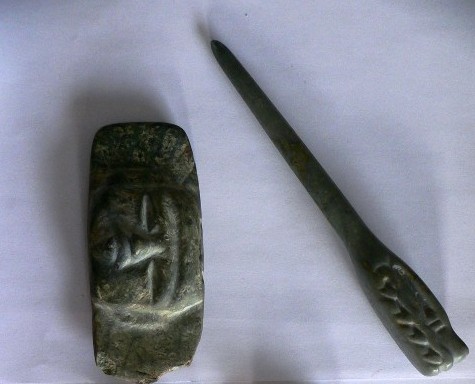
Catemaco Olmec Art

This certainly looks like Mayan or Olmec art.
Actually my neighbors kid did the outline to promote the local hop, skip & jump routine.
Or maybe it was just another neighborhoods kid scribbling on stone with a hammer and chisel, or maybe one of his country cousins trying to sell museum quality pieces to supposedly “rich” but not stupid Catemaco gringos at New York art gallery prices.
Picking up a little archaeological gift is easy in Mexico. Most any farmer plowing his land will find small ornaments. The bigger good stuff has already mostly been stolen and resides in foreign Museums.
But if you like, I will sell you a properly aged copy of an original piece at substantially less than what all those original art galleries charge.
Custom antique pieces will be charged extra, especially if you want something certifiably George Bush from the 8th century BC.


Aug 10, 2006

Catemaco Pesos


US dollars are white men’s money. That is white, as in WASP (white anglo saxon protestant men)

Here in beautiful downtown Catemaco, Veracruz, you get to spend racially mixed Pesos, with even a woman to fondle.

20 pesos - Benito Juarez - Zapotec Indian. He twice served as Mexican president in the mid 1800’s.
50 pesos - Jose Maria Morelos - Mexican of probable African/Spanish descent. Succeeded Miguel Hidalgo in Mexico’s fight for independence from Spain and was shot as a Spanish traitor.
100 pesos - Nezahualcoyotl - Indian ruler of the Acolhua (Texcoco) tribe. He joined the Aztecs in their Triple Alliance on their way to dominate Mexico.
200 pesos - Juana de Asabaje - Also known as Sister Juana Inés de la Cruz - Mexican of Spanish ancestry - a catholic nun, forerunner of the equal rights for women anywhere movement.
500 pesos - Ignacio Zaragoza - Mexican of Spanish ancestry born in Texas before secession from Mexico - As a general he defeated the French on Cinco de Mayo.
1000 pesos - Miguel Hidalgo - Mexican of Spanish ancestry - One of the cief instigators of Mexico’s war of independence from Spain.

PS - The now abandoned US 1,000 dollar bill featured Grover Cleveland, famous for being forced to pay child support and warring on Indian tribes.

May 3, 2006

Catemaco archaeology

So I had four happy well diggers burrowing into Catemaco shores on the "Say No to Gringos" day. 2.5 meters down (9 feet) the water started percolating. I stopped at 3 .5 meters because my suction pump could not fight the water penetrating through primarily gravel layers and I could not convince my soon to be archaeologists to proceed using snorkels. All that for 450 pesos per meter.

In addition, at the 1.2 meter level my well diggers, now known as archaeologists, unearthed a heap of historic artifacts, mostly pottery shards but also some stone objects. And according to them those were minor finds compared to what was found in other wells this troup had dug in beautiful downtown Catemaco.

I wonder what I would find if I turned my itty bitty front yard into an archaeological dig. And I wonder how many treasures have disappeared from most Catemaco construction sites.

My close neighbor, who runs a plant nursery, has a giant heap of pottery shards he collected from trenches he dug. And my partner talks of dozens of mysteriously disappeared finds.

Apparently those who lived here 1000´s of years ago did not have access to those indestructible plastic goodies, Made in China, that are now flooding the beautiful downtown Catemaco stores.