Jul 14, 2007

Catemaco - The longest small town bar in the world

The longest bar in the world seems to be a 208 meter monster in Rock island, Illinois, USA.

Runner up is the the agglomeration of almost 300 bars and pubs in the Altstadt of the town where I was raised, Düsseldorf, Germany.

I now waste away in Margaritaville, also known as beautiful downtown Catemaco, Veracruz, Mexico. With a city population of less than 30,000 and an average daily income of about 3 Happy Meals from McDonald, the town boasts of almost 200 cantinas, bars, nightclubs, beer dispensories, etc.

Most of these bars are furnished by beer companies and the city dump, and I would estimate, the number of chairs used, could easily fill in parts of Laguna Catemaco to create a causeway to Isla Agaltepec to really get to know monkeys in their own habitat.

The Catemaco municipio government probably spends considerably more money on drunk disturbances than it receives from licensing fees, yet tolerates an almost daily increase in drinking places.

Go ahead, have a cold one on me!

Jul 13, 2007

Catemaco Lightning

A little unannounced thunderstorm visited beautiful downtown Catemaco, Veracruz yesterday in the very early morning hours and tumbled 60 trees, 70 roofs, and some electricity posts.
Now I have spent many years in placed called boonies, in country, outback, etc., but I am not a country boy. So it came as a surprise to me to learn of the huge number of cattle electrocuted each year around the world.

July and August average 8 thunderstorms in Catemaco. And one of those freaks of nature hit our family mechanic´s life savings invested in a herd of 6 cattle and killed them all. So out came the machetes and the butchering and politicking over who would get the best meat started to broil. Our newly purchased dual AC minivan became the hearse of choice and transported slabs of beef to dozens of family members and other hungry folks.

Of course, the cattle were not insured, and I doubt that insurance was available or affordable to small ranchers. So now the poor mechanic is praying that all our cars require lots of his attention.
Curiously I am now living in a part of Catemaco which was previously a cattle ranch and known as Colonia of the Frogs, before a developer changed it to presumptious Linda Vista. According to my Popoluca the town used to eagerly await the lightning strikes this time of year, because the rancher would donate the electrocuted animals to the populace all eagerly lined up with their machetes at the cattle gates. And then it became party time.

The photo of lightning in Los Tuxtlas is from a forgotten source.

Jul 7, 2007

Buses and roads

Getting killed in a multiple passenger bus by a rock slide has got to be the fickle finger of some vengeful god. Why did he not choose one or two 2 passenger Ford Ranger pickup trucks so popular in Mexico?

The recent disaster of almost 40 dead in a land slide in Puebla, Mexico should be a caution sign to anyone traversing mountainous areas in southern Mexico. Let's not even speak about Guatemala, where death by mudslide is probably more frequent than death by intestinal diseases.

The dichotomy of Mexican roads, waffling between 21st century super highways to narrow 2 lane roads along precipices is just another symbol of 100's of years of corruption in road building and failure by Mexican engineers and their political sponsors to provide safe passage to its citizens.

Locally, each year numerous mud and rock slides disrupt the roads leading through Los Tuxtlas. Fortunately no full passenger bus has been affected recently except for a few that fell of bridges and some that missed a curve and plunged down 50 feet.

Fortunately there is a super highway bypassing Los Tuxtlas, at a cost of several days wages for the average local wage earner. That road is so unused and straight, that a blind person could possibly drive it except for those 1 foot deep potholes that unscrupulous Mexican contractors caused to be left behind to remind passing gringos who is boss in this part of the world.

I feel deeply sorry for those mud killed passengers, especially after reading they were mostly impoverished peasants, probably spending an entire day coming and going, to collect the equivalent of a 32 dollar Mexican welfare handout.

Those overhanging cliffs, though, are surely beautiful, especially on the roads through Oaxaca.

It is really a thrill there to stare up to a 1000 foot overhang while navigating a road along a 1000 foot dropoff. What a marvel of engineering that road between Puente Nacional and Oaxaca is. Those Mayans at their Chichen Itza rock piles simply do not compete, irregardless of possibly being declared an international monument today.

Jul 5, 2007

Matamoros to Catemaco

Crossing the border from Brownsville, Texas to Matamoros (Killing Moors) is a breeze along the newly opened border crossing at Puente Internacional. Leaving Matamoros is the pinnacle of further venturing into Mexico. You will be impresssed by fast roads leading through Tamaulipas, the state harboring Matamoros.

You will know you reached Veracruz when the roads turn to crap, smiling politicians laugh at you from most available lamposts, diesel fumes compete with your AC, your average speeds drops to 25 miles per hour and the landscape becomes beautiful.

If towing a vehicle or being otherwise out of the norm, Mexican "Federales" Highway Police Officers are some of the friendliest Mexicans you will likely encounter on Gulf coast roads. Locals usually tip these valiant officers 100 to 200 pesos after making their aquaintance. Usually these encounters have no relations to actual traffic infractions.Our last trip with 2 newly Matamoros purchased vehicle towing another, resulted in 6 traffic stops with a total of 2800 pesos in contributions to the Mexican police forces.

The downhill section from Catemaco to Matamoros produced not a single police stop, but 4 "get out of the car and get searched stops" by military personel. My Popoluca's son accompanying me told me it was because I did not smile enough when questioned.

The Texas to Yucatan highway has been around for several hundred years but has existed only a little more than 50 years in a paved version. Until recently, much of the roads seemed to hark to those previous glory days. Improvement has been slow and Veracruz now counts a dozen toll roads with many terminating abruptly and leading nowhere with signs to Mexico City.

Generally speaking, the roads from Matamoros to Tampico are good, with substantial road construction along a small part of the way.The Tampico bypass is open, but not pleasant! The exit to Veracruz City is only marked by a "Tuxpan" sign, and easily missed.The Tuxpan bypass is also easily missed and will provide you with several opportunities to have adventures on never before seen Veracruz roads. Poza Rica is even better to get lost in. Fortunately the roads between Tuxpan and Poza Rica are pleasant to drive.

A curious aspect of local highway construction is two way toll roads. They are usually accompanied by rather large road shoulders, in place of fifty foot drop offs. The locally acceptable norm for passing a car in in your lane, while there is oncoming traffic, is to demand that the car in front of you drives to the shoulder in order for you to pass in the middle of the road. Opposing traffic usually plays by these rules and also moves to the shoulder, and you can safely pass in the middle of the road, frequently along 34 wheel tractor trailers, unless of course you meet a dumb foreigner like me who did not understand this game and sticks to his lane. In that case you might receive a side swiped mirror as occured to me when I first encountered this type of road near Cancun many years ago.

From Poza Rica to Veracruz is fairly easy going amid an attractive landscape. Bypassing Veracruz on the way to Catemaco is easy and well marked, until you get to the Paso the Toro exit, which might send you to Cordoba. The road to Los Tuxtlas at present is better than it has been in 5 years, which might not be true tomorrow.

Total driving and stopping time is 14 hours, taking advantage of the lack of speed controls, or 17 driving comfortably or 2 days, sightseeing.
COME ON DOWN

Jun 22, 2007

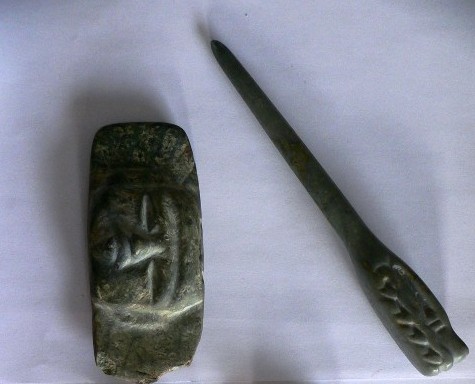
Catemaco Olmec Art

This certainly looks like Mayan or Olmec art.
Actually my neighbors kid did the outline to promote the local hop, skip & jump routine.
Or maybe it was just another neighborhoods kid scribbling on stone with a hammer and chisel, or maybe one of his country cousins trying to sell museum quality pieces to supposedly “rich” but not stupid Catemaco gringos at New York art gallery prices.
Picking up a little archaeological gift is easy in Mexico. Most any farmer plowing his land will find small ornaments. The bigger good stuff has already mostly been stolen and resides in foreign Museums.
But if you like, I will sell you a properly aged copy of an original piece at substantially less than what all those original art galleries charge.
Custom antique pieces will be charged extra, especially if you want something certifiably George Bush from the 8th century BC.


Jun 16, 2007

Drunk in Catemaco

Below the belt of most Mexican rural towns, including beautiful Catemaco, Veracruz, dangles a pair of culture threatening problems, drunkenness and spouse abuse. The two are closely related to each other and form a basis for the extraordinarily high incidence of murders, mutilations and roadkills in the country.

At present federal Mexico does not tax alcohol, aside from the 15% tax added to most consumer products. The concept of sin taxes is not absent in Mexico. The booze manufacturers have just been able to excert their political prowess more than the tobacco companies which are heavily taxed.

Especially at night, the prevalence of public drunks is pernicious in most of downtown Catemaco, as well as many other communities, especially on the weekends and on the highways, despite the efforts of Alcoholics Anonymous (AA) which is hyperactive here as well as in the rest of Mexico, providing 9 local refuges in this town of 20,000, and more than 22 in neighboring San Andrés Tuxtla.
Not helping is the cheap availability of rot gut "aguardiente" (firewater, distilled from sugarcane) at the equivalent of a short quart (26oz) of 72 proof liquor for 12 pesos. Even cheaper is the purchase of distilled alcohol from many grocery stores in any amount as long as you bring your own container. If you see a "wino" waving along the street clutching a plastic bag, containing what seems to be water, that will not be his goldfish, but a "churrito" or "boli" of brandless alcohol.
Firewater is the preferred choice of hard core drunks. The most problematic choice, though, is beer.
Mexico has a well deserved reputation for excellent beer quality and was able to fool the US public by exporting a third rate beer to the US market, where it rapidly cornered the "most imported " beer status and drove up the price of limes, Corona.

Corona and a few other breweries in the tightly controlled Mexican economy offer their most popular serving in "caguama" size bottles, (940ml, roughly a quart) for 14 pesos which compares to a similar bottle of Miller's "low life" for US 1.65 which is after the alleged 44% taxes which US alcohol consumes. Obviously Mexican drinkers are being ripped off by their compatriots controlling distribution channels.

The beer companies, aside from almost monopolistic Coca Cola, and Nestle are possibly the best marketers in Mexico and make it possible for any Jose or Juana to open a cantina on shoe strings, receiving free chairs, tables, refrigerators, decor and paint as long as they stick to selling one brewery's products.

The partial benefactors are the county governments (municipios) which charge a relatively high rate for liquor licenses, but not anywhere the huge sums that these licenses cost in the US.
The mayhem, roadkill and spouse abuse are additional benefits which are not included in the license fees and usually get picked up by state and federal funds.

The Mexican government, which is statistics happy, has made substantial studies of the drinking problem in urban areas, but seems to be avoiding the rural areas, where the problem is much more prevalent.

One final comment, which is not an endorsement, is to say that I have remarkably found those public drunks in Catemaco to be generally courteous and non-intrusive compared to many others I have encountered in my travels in other countries.
Cheers.